 Lost Calves
Browser
webArrow keys, buttons and an emoji board.
Your game is kept for you: close the tab and carry on later.
web.lostcalves.cloudfuture.io
A storm scattered your calves onto wolf ground. Sneak through the tall grass, shout, or use your slingshot, and get them back to the barn by nightfall.
It's one small game, and you can play it in a browser, a terminal, Telegram, your inbox, Gopher, Gemini or a website from another century.
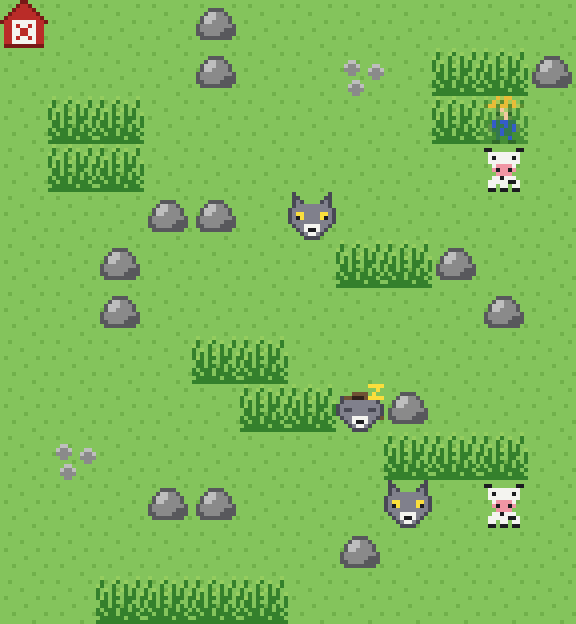
One meadow, two calves, three wolves, and about a hundred turns of daylight.

Two calves are out in the meadow. Walk into one and it follows you, but now and then it bleats, and wolves hear that.

Wolves keep to the ground around their den and look in straight lines. Rocks block their view and tall grass hides you. A wolf that spots you stops and stares first: that's your warning. If it sees you again, it charges.

Get every calf into the barn before the daylight runs out. The barn is safe and gives you back your stamina.
Move with w a s d (or the arrow keys or buttons). . waits, h shouts, f plus a direction fires the slingshot, x turns on x-ray to show what the wolves can see. You can type several moves at once, like d d s, and the plan stops if a wolf notices you.
These are real boards from one game (seed 7), drawn by the game's own pixel-art renderer.
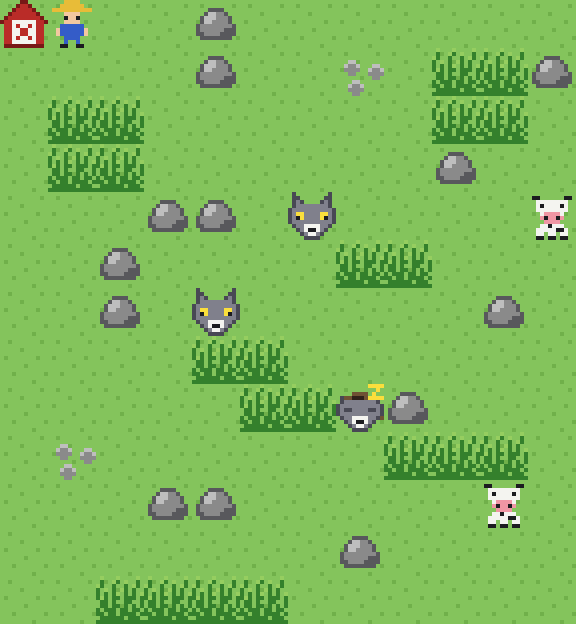
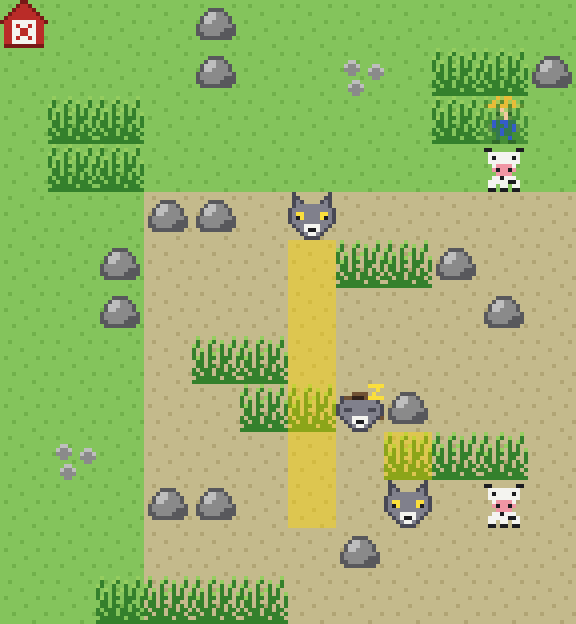
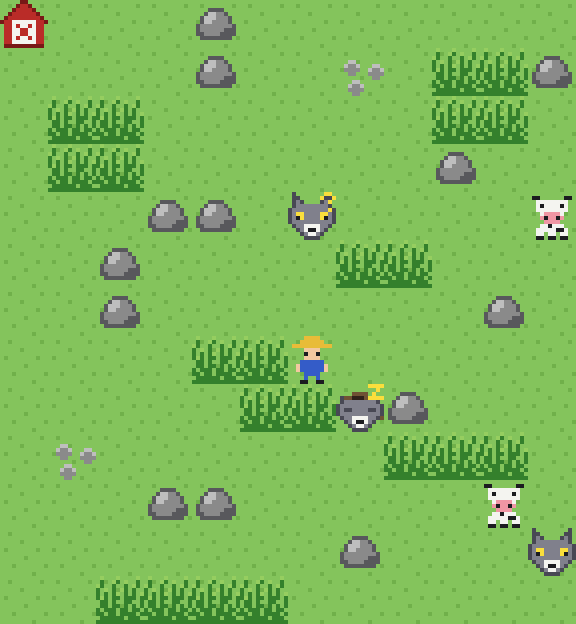
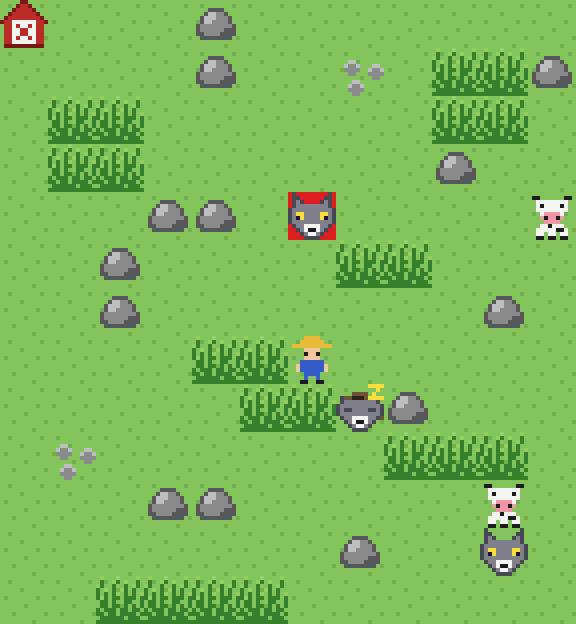
Every version below is the same game with the same rules and the same commands. Pick whatever you have open.
Arrow keys, buttons and an emoji board.
Your game is kept for you: close the tab and carry on later.
web.lostcalves.cloudfuture.io
Tables, forms and no JavaScript, built the way sites were in 1999.
Coming soon.
retro.lostcalves.cloudfuture.io
A box-drawn board in your terminal, with nothing to install.
telnet telnet.lostcalves.cloudfuture.io
A D-pad under the board, or the board as a picture that fits any phone. Add the bot to a group and play one game together.
@farmerjohn2026_bot
Play by mail. Send a whole plan in one email and get the board back in the reply.
Put your moves on the first line, e.g. s s d.
Coming soon.
play@mail.lostcalves.cloudfuture.io
Plain-text menus with a link for every move.
gopher://gopher.lostcalves.cloudfuture.io
Gemtext pages: tap a link to move, or type a whole plan.
gemini://gemini.lostcalves.cloudfuture.io
Clone the source and run it locally, in four board styles. You can pipe input in: echo "s s d" | npm run start:cli
npm run start:cli -- --style=dos
A JSON API that returns the board as named cells (calf, wolf_chase, ...) rather than symbols, so you can draw it however you like.
npm run start:api
You can type a whole route at once: s s s s s s s d d d d d d d d. The game carries it out move by move and stops as soon as something needs your attention, such as a wolf that stares, charges or bites, or a sleeping wolf that wakes up. It then tells you how many moves it skipped.
This is what makes the slow front ends playable. One email is one plan, and the reply shows where you stopped and why.
A wolf (3 up) stops and stares at you...
(Stopped: 3 more commands not carried out.)

+-------------------------+
| H . . . # . . . . . . . |
| . . . . # . . o . " " # |
| . " " . . . . . . " " . |
| . " " . . . . . . # . . |
| . . . # # . ? . . . . c |
| . . # . . . . " " . . . |
| . . # . . . . . . . # . |
| . . . . " " @ . . . . . |
| . . . . . " " z # . . . |
| . o . . . . . . " " " . |
| . . . # # . . . . . c . |
| . . . . . . . # . . . v |
| . . " " " " . . . . . . |
+-------------------------+

Daylight    ##################-- 88
Stamina     ########## 10/10
Stones      ooo
Calves      ? ?  0/2 home
Lost Calves started as one small grid game and a question: what is the least a screen needs in order to play it? It turned out to be not much. The game itself knows nothing about how it gets drawn. It takes a line of text like d d s and reports what happened. Each front end is a thin layer that draws the meadow its own way.
Slow channels needed one change to the game. If a move takes a link click or an email round trip, you want to send several at once, but a plan that marches straight into a charging wolf is no fun. So plans stop as soon as something needs your attention. That one rule is why the game plays well over email, and it makes the fast front ends nicer too.
Yes. There's nothing to buy, and no account or sign-up.
No, if you play in the browser, on the retro site, in Telegram, by email or over telnet. Gopher and Gemini need a client for that protocol. Running it locally needs Node.js.
A few minutes. You have about a hundred turns of daylight, and a careful game uses most of them.
One so far: The Meadow. More fields, a map of fields to travel between, and gear that gets damaged are on the roadmap, but they are plans, not promises.
Games are kept in the server's memory while you play, and a restart of the server ends them. There are no accounts and no saves.
In Telegram, yes: add the bot to a group and everyone moves the same farmer. The browser version also runs one shared game for everyone who opens the page.
It decides everything random in a game, such as how tough each wolf is and when a calf bleats. With the same seed and the same moves, you get the same game. If something odd happens, tell us the seed and we can replay it.
A view toggle that shows each wolf's ground and what it can see. It doesn't cost a turn. Use it to learn the wolves, or leave it off and play by instinct.
Because it works anywhere, and because playing a turn-based game by mail is an old tradition that still works.